

A Detailed Guide on How to Process Design Thinking for Your Project
Customers are an essential part of every design process. The whole design process revolves around them. In this regard, an in-depth understanding of the potential customers is crucial for design success.Design thinking will help you understand your potential customers and their pain points.
It follows a strategic process to identify customers at different levels. Therefore, it is widely used in the UX design process.
In this article, you will learn about design thinking and its major aspects. Furthermore, you will learn how to process design thinking.
Brand architecture is the strategic arrangement of a company’s brands, sub-brands, products, and services, defining their relationships and hierarchies. It provides a structured framework that enables customers to understand a company and its interconnections. The well-crafted brand architecture ensures coherence while allowing differentiation among different offerings.
What is design thinking?
Design thinking is an iterative and non-linear process used by the design teams to understand potential users. It involves:
- Identification of the user problems.
- Clarification of the design process
- Prediction of the practical solutions
Design teams execute design thinking to uncover the users’ hidden problems and pain points. In this way, they help create better products and services. Ultimately, design thinking helps improve the user experience.
Benefits of design thinking:
Design thinking greatly improves the product or service design strategy. It benefits a design project in the following aspects.
- Design thinking identifies the core problems and needs of your potential clients. It involves innovation and creativity. Therefore, it suggests innovative ideas according to modern needs. Hence, it helps satisfy the needs of modern humans.
- Design thinking is a problem-solving technique for your product design. It determines the possible problems related to your product or service. This way, it removes the obstructions in the path of design success.
- The significant benefit of design thinking is to estimate solutions to unknown user problems.
- Design thinking smoothens the process of user research, prototype building and usability testing.
- Design thinking provides innovative ideas to develop the design process. These innovative ideas are the result of collaboration. Multiple design groups generate creative output for a feasible and sustainable design model.
- Launching a successful design process from a creative idea is a risky task. You will need a clear understanding to assess the probability of success. In this regard, design thinking will help you evaluate the pros and cons of launching a new idea.
5 crucial aspects of design thinking:
The building of design thinking stands on several crucial pillars. These pillars represent a successful design thinking strategy. Therefore, your design thinking process should execute these design aspects to generate viable design output.
- User-oriented approach:
The foremost requirement of a perfect design thinking process is the user-oriented approach. You should inquire in-depth information about your targeted customers. You should know about their pain points, desires, expectations, motivations, and needs. In this way, the design innovation will be based on users. Ultimately, it will lead to design success.
- Collaboration:
Design thinking is a collaborative task. It involves the active participation of all the members of the design teams. In this way, they come up with brilliant ideas for innovative design structures.
- Ideation:
Ideation is the result of collaboration. Multiple stakeholders in the design teams share creative ideas. These creative ideas enhance the ideation process. A free-thinking environment with no criticism and judgement over ideas significantly beautifies this process. Hence, every creative leads towards a pure ideation process.
- Experimentation and iteration:
A successful design thinking process involves experiments and iteration. Your design teams will need to iterate the different design thinking phases to redefine user problems and their solutions. Furthermore, you will need to experiment with new ideas to finalize your product design.
In this regard, building a prototype and conducting usability testing greatly help. Eventually, you will achieve your envisioned design module after successive experiments and iterations.
- Actionable plan:
Design thinking also works on practical plans. It doesn’t rely on perceptions only. Therefore, you will require to experiment with the actual user experience with your design team. In this way, you will get practical solutions.
Design thinking methodologies:
Design teams use different design thinking methodologies and techniques for a successful design project. We have mentioned the most popular design thinking techniques here.
- 3-phase design thinking technique:
3-phase design thinking revolves around desirability, feasibility and viability.
Desirability:
Desirability refers to the customer desires and expectations. It answers:
- What are the desires of the people?
- How do they respond to products and services?
You can discuss with your design team to find out the desires and needs of the users.
Feasibility:
Feasibility will tell you about the probability of the desire fulfillment. You may not fulfill all the user desires. Furthermore, some user desires may not be possible. Therefore, you can find out the feasible desires with creative design thinking.
Viability:
Viability is the most important part of this design thinking process. You should know how to incorporate the feasible desire into a sustainable business model. Your business has its requirements. You can decide the viability of a design idea based on the business requirements. In this way, you can process a sustainable and innovative design project.

Image credit: 3-Phase Design Thinking Process
More Articles to Read


2. 4-phase design thinking technique:
You can also use this design thinking technique to formulate your design thinking strategy.
- Information gathering via observation, empathy, and interviews:
Information about potential customers is vital for design thinking. Design thinking doesn’t rely on perceptions. Therefore, you will need a solid understanding of the users. In this regard, your design team can use observation techniques and user interviews. You will get beneficial results by empathizing with the users.
- Building prototypes to experience user expectations:
Design thinking also involves practical tasks. Your design team can create a prototype to experience user expectations. In this way, you can get crucial information about the user experience. Furthermore, a viable prototype will help you formulate the product design efficiently.
- Generating problem statements and their solutions:
You can use this step before and after building a design prototype. This phase involves writing problem statements from the user pain points. These statements help define user problems effectively. Hence, the design team can easily suggest practical solutions to the problems.
- User research for an in-depth understanding of the potential audience:
Design thinking will help conduct in-depth user research. You will better understand users and formulate strategies. In this design thinking phase, you will need to research the past, present and future of the users.
You will find the answers to these questions:
- What’s the current situation of the users?
- What are the future design improvements?
3. 5-phase design thinking technique:
Hasso Plattner Institute of Design, Stanford, proposed this design thinking model. It is the most popular and widely used design thinking process. This methodology includes the phases of empathize, define, ideate, prototype and test.
- Empathize:
User understanding is crucial. Therefore, you and your design team need to empathize with your potential audience. You can observe and research user experience to get a real understanding of the user needs. Furthermore, talk to your design team for a mutual understanding.
User research is an excellent help in this phase. You will get deep analytics and fundamental insights about the users. It will help to create a user-oriented design product.
- Define:
Next step is to define your users. Information collected via empathy will help produce problem statements and personas. Furthermore, you will get a clear understanding of the user problems. Hence, your team will be able to prepare practical solutions. These practical solutions will be evident in added features to the product design.
The most important part of this phase is problem statements. These are focused on your perception of the user expectations. Simply put, problem statements describe user problems. They trigger the process of design innovation.
- Ideate:
Ideation process focuses on generating ideas from the problem statements. A design team can generate multiple ideas via the ideation process. This process triggers thinking out of the box for a perfect design. In this way, you will get extensive ideas from different perspectives.
The prominent ideation techniques are:
- Brainstorming
- Brainwriting
- Scamper
- Worst Possible Idea
You will envision the user problems and their practical solutions with the help of these effective techniques.
- Prototype:
Prototype is an experimental phase which acts as an early version of your product or service. It tests user experience via a design template. Your design team will create a user-oriented prototype to identify the actual user experience. Hence, this phase will help determine the improvement areas.
- Test:
After creating a prototype, the design team will test it. This test will help you:
- Redefine user problems
- Add improvements
- Know the design flaws
After this phase, you can move back to the previous stages to improve the flaws. Hence, the iteration process will follow after testing the prototype to improve results.

Image credit: 5-Phase Design Thinking Process
4. 6-phase design thinking technique:
You can also use this 6-phase technique to process your design thinking strategy.
Frame a question:
This phase is similar to the first phase of every technique. You will need to identify a user pain point or desire. This user problem or need will help produce innovative solutions.
Gather inspiration and information:
In the next step, you will need substantial information about the users. You can conduct observations, interviews, and surveys to gain user information. Furthermore, you can get inspiration for your design thinking process from competitive analysis and existing creative ideas.
Generate ideas:
Ideation process repeats itself in every design thinking methodology. You can generate creative ideas with your design team in a free environment. These ideas will help you define your design project’s initial structure.
Prototype (Make ideas and solutions tangible):
Prototype is the initial result of the ideation process. It bases on the recorded user experience. Your design team will create a design prototype for the product or service. It will help in the later testing process.
Testing and learning:
Prototype and usability testing are the main requirements of this phase. After the test, gather feedback from the stakeholders and users. You will move back to the previous stages for further experiments and improvements.
Create a human-centred story:
Stories have a deep emotional touch. You can utilize them to create a good user experience. You can include the whole design thinking process in the story for inspiration. This way, it will reflect the user research and experience effectively.
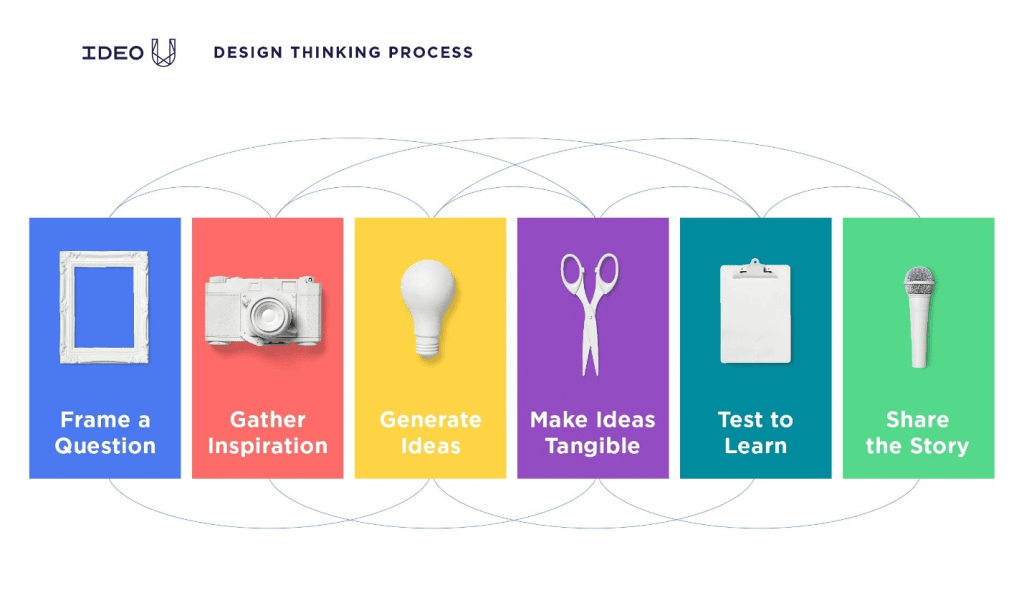
Image credit: 6-Phase Design Thinking Process
Design thinking is a creative process. You will enjoy the whole design thinking process with your design team. It will help you deduce beneficial user understanding.
You can use any design thinking method for your business. It totally depends on your convenience.
Furthermore, design sequence doesn’t matter a lot. You can execute the design phases parallel or iteratively. You can also add additional steps or miss any step. It all depends on your requirements.
The main goal of design thinking is user understanding. If you can achieve this goal with your own customized design thinking process, it’s enough. You can still create better products or services. You only need to apply the essential aspects of design thinking.
Additionally, these design thinking techniques act as a guide. You can use them to formulate your own creative process. Ultimately, your goal should always be user understanding.